

Software development is a collaborative effort involving a group of people working together to build a software solution that solves a business problem. Within this team, each individual plays a specific role, and every role comes with its own set of responsibilities.
Although the software development process can differ from one company to another, there are common principles that exist in every organization. Understanding these principles and roles helps clarify how an abstract business need is transformed into working software.
Core Principles of Software Development
While implementation varies across companies, every software development process includes several fundamental steps:
- Understanding the business problem
- Documenting the solution in non-technical, functional terms
- Translating the functional solution into a technical architecture
- Converting the architecture into actual code
- Managing developers and the development process
- Testing and deploying the software
These steps form the backbone of any successful software project.
Key Roles in a Software Development Team
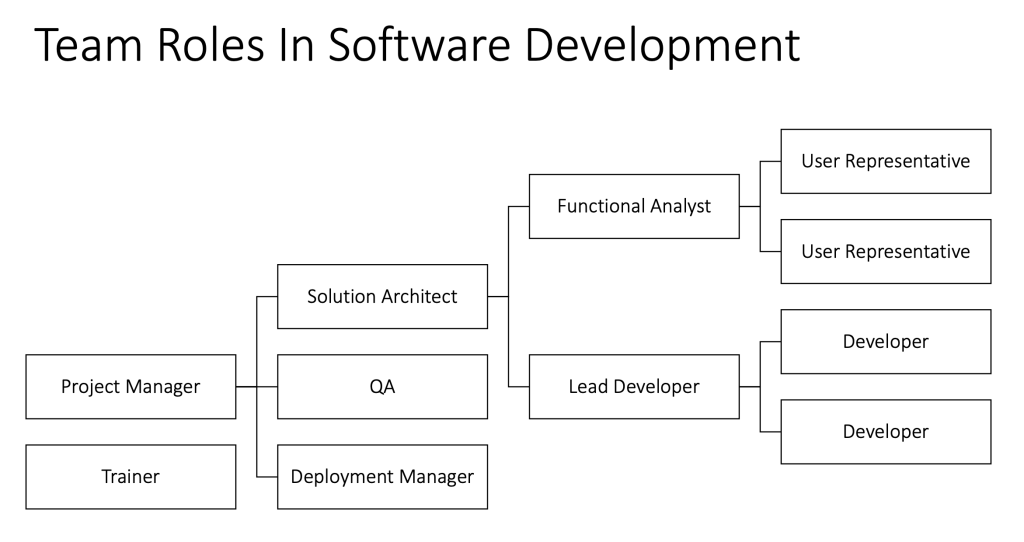
User Representatives
User representatives are business users who will eventually use the software. Since there are often many end users, one or two individuals are chosen to represent the entire group. Their main responsibility is to communicate business needs and expectations to the development team.
Functional Analyst
The functional analyst gathers input from user representatives and turns it into a functional requirements document. This document describes what the software should do, focusing entirely on functionality rather than technical implementation. It outlines user interactions, workflows, and system behavior in an abstract, non-technical way.
Solution Architect
The solution architect translates functional requirements into a high-level technical architecture. This includes diagrams and conceptual designs that describe system components, communication patterns, and overall structure—without going into code-level details.
Lead Developer
The lead developer is responsible for implementing the architecture and leading the development team. This role involves breaking down the architecture into manageable tasks, guiding developers, writing code, and acting as a technical mentor for the team.
Developers
Developers work under the guidance of the lead developer to implement the software. They write the code that brings the architecture to life and ensure that the solution meets the defined requirements.
Quality Assurance (QA)
Quality assurance is responsible for testing the software to ensure it behaves according to the functional requirements. QA creates and executes tests—ideally automated—to continuously verify code quality. Frequent testing leads to higher-quality and more reliable software.
Deployment Manager
The deployment manager handles the process of deploying software to staging and production environments. This role is often separate from the development team for security reasons, ensuring that only authorized individuals have access to production systems.
Project Manager
The project manager oversees planning, scheduling, and milestones. They are responsible for ensuring that features are delivered on time and that the project progresses according to the agreed timeline.
Trainer
In larger organizations, a trainer may be responsible for coaching and upskilling the IT team. This role ensures that team members’ skills remain up to date and aligned with project needs.
Essential Skills for Everyone in the Team
Regardless of role, certain skills are essential for everyone involved in software development:
- Understanding the business – Knowing the business goals increases the chance of building useful software.
- Cross-domain understanding – Having basic knowledge of other roles improves communication and collaboration.
- Multiple perspectives – Being able to see problems from different viewpoints is crucial, especially for leadership roles.
- People skills – Effective communication is key in large, collaborative projects.
- Lifelong learning – Technology evolves rapidly, making continuous learning a necessity for long-term success.
Conclusion
Software development is more than just writing code. It is a structured collaboration between multiple roles, each contributing to turning a business problem into a working software solution. Clear responsibilities and strong foundational skills across the team are essential for delivering high-quality, sustainable software.
Source: https://www.udemy.com/course/how-to-become-an-outstanding-solution-architect/

